Medical Self-Care: Your School Bag
Putting together a basic medical kit for home use.
By the Mother Earth News editors
July/August 1979
Issue # 58 - July/August 1979
"What people get trained to do in medical school-and dental school, and other institutions of medical education-is diagnose and treat disease, and a lot of times we tend to call this `health care'. In fact, it's illness care. And I think that one reason self-care is getting to be so popular now-and my magazine (Medical Self-Care) is by no means the equivalent of the self-care movement . . . it's just a small part of it-is that consumers are starting to see professionally delivered illness care for what it is. And one thing it's not is 'health care'.
"People are beginning to realize this now and they're looking for alternatives. Doctors and consumers alike are beginning to look, for instance, at illness care delivered by lay people, and wellness care delivered by professionals. All of these new ways of looking at what we've been lumping together and calling `health care' are addressed in some way by the idea of self-care . . . which is simply the notion that the primary health resource in our society is not the physician, but the lay person himself or herself."
Do the above words sound familiar? They certainly should to regular readers of MOTHER . . . because such folk have heard 'elm before, back in Issue No. 51 when we first interviewed Tom Ferguson. And those of you fortunate enough to have had that exposure to Tom and his ideas on self-administered, group-supported medical care may remember that-at the time of his Plowboy Interview-the young man from California was completing his formal medical education at Yale . . . and, not so coincidentally, editing an outstanding fledgling publication titled Medical Self-Care: Access to Medical Tools.
Well, Tom Ferguson is now Doctor Tom Ferguson and (wouldn't you know it) the concept of medical self-care itself has become contagious. It, seems that more and more people are aware of the ideas pioneered by individuals such as Dr. Keith Sehnert his book How to Be Your Own Doctor (Sometimes), $4.95 from Grossest & Dunlap, 51 Madison Avenue, New York, New York 10010-and furthered by the likes of Tom Ferguson.
The word is getting out that the lay person can-in fact, must-learn more about those subjects (like nutrition, body awareness, self-examination, and so forth) heretofore held to be comprehensible only to "the doctor".
Such an education is just plain healthful. MOTHER thought so back in Number 51 when we introduced our readers to Tom Ferguson. Then, to carry on the "story", we took you all the way to Russia in "A Firsthand Look at Health and Nutrition in the Soviet Union" in Issue No. 53 . . . talked to Dr. Harold Manner in No. 54 . . . even showed you how to-in certain cases be your own veterinarian (in Issue No's. 52-57) . . . had Dr. Robert Nara give his views on preventive dentistry as the subject of the Plowboy Interview in No. 56 . . . and the list goes on and on.
Need we say more? We think so, because starting in this very issue, THE Mother Earth News(restricted) is gonna offer-as a regular feature-a piece by Tom Ferguson, M.D., called (what else?) "Medical Self-Care".
Enjoy . . . and learn!
Remember the old-fashioned school bags that seemed-in childhood days-to signal the beginning of each new educational experience, the sacks that were carefully packed with all the basics you felt you needed for the upcoming endeavor? Well, that's exactly what we're about to put together . . . a school bag for medical self-care.
References. Get hold of Keith Sehnert's How to Be Your Own Doctor (Sometimes) from a local bookstore or from the address mentioned in the introduction to this article. Read it. Use it. In addition-especially for women's self-care-buy a copy of Our Bodies, Ourselves . . . by the Boston Women's Health Book Collective. This revised text is currently available for $5.45 (postpaid) from Simon & Schuster, 630 Fifth Avenue, New York, New York 10020.
Tweezers. This is the most frequently used item in my own "school"-or black-bag. Get a good pair and don't use them for tightening screws and such. There's nothing more infuriating than having a sobbing child (or adult) stretched out across the couch with a splinter in his or her foot, and then discovering that the tweezer tips don't quite come together. Keep this valuable tool dry-and in its case until you need to use it!
Tweezers are available-for minimal cost-in most drugstores. For tiny splinters, I also use a pocket-sized magnifier . . . to get a better look at what I'm pulling out. These little "glasses" can be found (for a dollar or less) at a photo shop.
Thermometer. A good thermometer can be had for between $2.00 and $3.00 in any drugstore. Always clean such instruments with cold water, as heat may cause them to break. Keep an oral thermometer on hand for adults and most children, and the rectal type (always use a lubricant such as vaseline with a rectal thermometer) for infants. Remember, too, to always shake your thermometer down to below 98°F before taking anyone's temperature.
An oral thermometer should be placed under the tongue for at least three minutes. (Be sure the "patient" hasn't had anything to eat or drink in the previous few minutes.) Rectal thermometers should be left in place for the same length of time, and will generally read about 1 ° higher than will the oral units.
It should be noted that most doctors don't consider a temperature under 100°F a fever, and that an individual's temperature will rise after exercising (or Immediately after a woman ovulates . . . which is a handy way to determine when you're fertile: See page 10 of Our Bodies, Ourselves).
Stethoscope. Obtain a stethoscope with a diaphragm (a round, flat disc) on the end rather than the type with the hollow, bell-shaped chestpiece . . . and ask a medical worker to show you how it's used to listen to hearts, lungs, and abdomens . . . as well as in taking blood pressure readings.
The earpieces of most stethoscopes are set at an angle. Put them in your ears so that the tips point toward the front. The spring that connects the two earpieces may be bent in or out to make the device fit snugly but comfortably.
Most local hospital or medical supply stores, Sears, your local druggist, or even Edmund Scientific (Barrington, New Jersey 08007) will carry stethoscopes. Prices begin at around $7.00 to $10.00.
Tongue Blades. You can purchase tongue blades at hospital supply stores. However, it's often not necessary to use anything to hold down the tongue at all. (Try asking the person to open his or her mouth wide and pant in and out like a dog . . . or-in a pinch use the handle of a clean spoon as a substitute depressor.)
Blood Pressure Cuff. (This valuable piece of equipment will run about $20 (at Sears or J.C. Penny) and up. Drugstores are beginning to carry kits with stethoscopes and blood pressure cuffs. (You usually need both to take an accurate blood pressure reading.)
These are three types of cuffs in common use: mercury column, aneroid, and electronic aneroid. The last named is the "latest thing", and uses a microphone under the cuff rather than a stethoscope-to detect the arterial sounds. The March 1979 issue of Consumer Reports has an excellent article on some 30 different cuffs. Copies of the story are available-for $1.00 each - from Consumer's Union, 256 Washington Street, Mt. Vernon, New York 10950.
Check your own "self-care" blood pressure readings against those taken by your doctor . . . just to make sure your cuff is accurate. Remember, also, that emotional factors (like being at the doctor's office in the first place) can cause your blood pressure to shoot up . . . so readings should always be taken when the patient is comfortable and relaxed.
A booklet-with all the information you'll need to take accurate blood pressure readings - is available free from your local American Heart Association, or from their national office, 44 East 23rd Street, New York, New York 10010.
Flashlight. Penlights are more convenient to carry than fullsized"handlamps", and are better for checking pupil size ... but the big lights last longer and can do double duty around the house or when you go camping. In addition, large flashlights are better for looking into throats . . . which is the purpose they'll likely serve most frequently.
Flashlights are also useful for examining noses, looking into eyes for foreign matter, providing light while removing splinters, and finding dropped contact lenses. (Turn the room lights off and shine the flashlight across the floor. The lost lens will make a tiny shadow.)
Reflex Hammer. Reflex hammers aren't really necessary for most general medical kits, but they're lots of fun and highly educational to use. Expect to pay about $5.00 at most medical suppliers.
What Else? As your medical self-care education continues, you may consider adding an otoscope (for viewing and examining the ear), a vaginal speculum (for vaginal self-examination), and any number of other tools. In fact, an excellent kit-with stethoscope, blood pressure cuff, otoscope, penlight, both oral and rectal thermometers, tongue depressor, dental mirror, instructions, a self- help guide by Keith Sehnert, and even a sturdy vinyl bag to carry it all in -is available for $79.50 postpaid from The Health Activation Network, P.O. Box 923, Vienna, Virginia 22180.
However, your most valuable tool will be a good working knowledge of your body and how to read it and respond to it. Enroll in (or help organize) a self-care course in your area. A listing of such courses is updated in each and every issue of Medical Self-Care.
EDITOR'S NOTE: Tom Ferguson's quarterly periodical, Medical Self-Care (P.O. Box 717, Inverness, California 9493 7) is available at the following rates: ,) $10 for one year, $25 for three years, and $250 for a lifetime subscription. Back issues of the magazine five of which are currently available) are sold for $2.50 apiece.
And MOTHER NO. 51 which contains the Plowhoy Interview with Dr. Ferguson -is available (for $3.00 plus $1.00 shipping and handling) from THE Mother Earth News(restricted). P. O. Box 70, Hendersonville, North Carolina 28739.
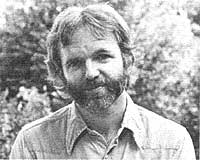
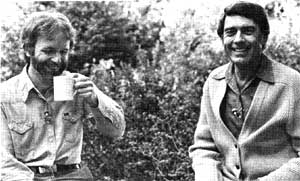
Dr. Tom Ferguson and Dan Rather. . . photographed during a recent interview.
|
|
|