Homegrown Music And...Musical Instrument! The Homegrown ""Bonker Box""
By Marc Bristol
July/August 1979
Even homesteaders need to relax and enjoy themselves from time to time, right? And almost everybody these days wants to cut his or her cost of living. So how about a little do it-yourself entertainment?
And that's what this column is all about. Down-home music that you can make . . . and the instruments (which, in some cases, you can also make!) to play that music on.
We may also publish some songs, discuss music as a potential home business, run discographies, bibliographies, and/or include whatever other do-it-yourself music topics you'd like to see.
The important thing is that this is a new column. If you like it, write to me and let me know. If you have some ideas for this feature, let me know that. I'm open to any suggestions or information you care to contribute. I'll even try to answer your questions about down-home music . . . but-both for the benefit of all MOTHER's readers and to ease my correspondence load-I'll deal with those questions, whenever possible, here in this column . . . rather than in personal letters.
Address your correspondence for this column and this column only-to Marc Bristol, 31722 N.E. 180th Place, Duvall, Wash. 98019.
MOTHER-reader Irene Scyriver wrote me-not long ago-to ask for information about building a "mystery drum" . . . which she described as "an oblong wooden box-with a grooved surface that's played with padded sticks."
As luck would have it, soon after I received Irene's letter I happened to hear Mark Filler playing such an instrument (he called it a "tongue drum") on a local "live" radio show. So I contacted-Mark and got the whole scoop on these unusual percussion musicmakers.
It seems that the wooden instruments go by any one of a number of names. So to eliminate any unnecessary confusion (and because we'll be talking about building our own "drums" and ought to be able to call 'em what we like), I've chosen the name "bonker box". Here's how to make one for yourself:
IF I HAD A HAMMER . . .
To begin, gather a supply of 3/4-inch planks. The lumber that will be used for the top of the box-which is the sounding surface-should be a hardwood . . . such as oak or Honduras mahogany (oak planks can often be scrounged from pallet boards or even junked furniture). You shouldn't have much trouble locating this material at a reasonable price. After all, small sections of lumber are pretty easy to come by (and most "bonkers" are around a foot long, while the biggest I've ever seen was only 27 inches in length). Hold your chosen board by a corner and rap it with a knuckle. If it rings, you've got yourself a good one!
The planks used on the instrument's sides and bottom are not as critical as is the "top" material. Just remember that harder wood will generally produce a brighter tone.
As you may have guessed, bonker box dimensions can vary over a considerable range. The size of your drum will be determined by how you plan to play the instrument. Since the base of the box should never rest solidly on a surface while the music maker is in use, a small unit-which can be cradled between your knees-is the best bet. (If you decide to make a large drum, build a stand for it, or at least set the box up on strips of rubber or felt so as not to damp the tone.)
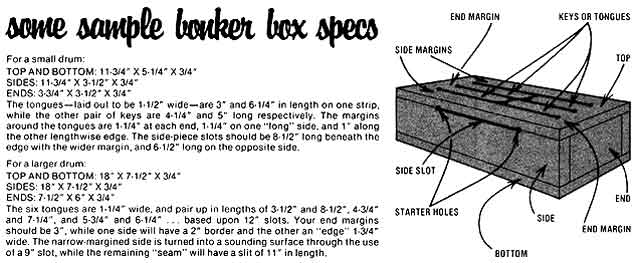
Although it's possible to construct a bonker box with the simplest of hand tools, you'll find it easier to get tight joints (and superior sound) if you use a table saw or jointer. Folks who don't happen to have the appropriate tools may be able to barter with a local handyman for the labor . . . or buy the boards from a lumberyard that'll cut 'em to shape. (And, for those people who have no wish to design their own bonker boxes, I've included the complete dimensions for two sample drums in the sidebar that accompanies this column.)
The slots in the drum's top-which produce the tongue-shaped keys-can be made with a drill and a jigsaw or saber saw. Each note maker should be 1" to 1-1/2" wide . . . and the margins around the keys-on all four sides should be of similar (but not necessarily identical) widths. (The long margins will-on drums with a slit along the box's side boards-produce tones of their own . . . so you may want to make these borders of unequal widths to increase your instrument's "range".)
Lay out the proposed cuts-with pencil lines parallel to the lengthwise edges of the plank. If your top is to be 6" wide, for example, you might draw the first line at a point 1-3/8" from the edge, the next scribe 11/2" farther, and another after a second space of 1-1/2" . . . which would leave a 1-5/8" margin on the far side. (These dimensions, of course, will be diminished by the width of your saw blade . . . perhaps by as much as 1/8". )
Now draw two lines-perpendicular to your lengthwise scribes-to establish the short outside borders of your musical tongues. Be sure that these margins (on the lid's ends) are at least as wide as those on the sides. Drill 3/8" "starter holes" for your saw blade where the two sets of lines intersect. Then simply use the saw to cut a narrow slot between each pair of holes ... following the "long" pencil marks as you go.
To determine the lengths of the instrument's tongues, first find the center point of each parallel cut. You'll want to slice across the slit bordered bands at points that are slightly off center, and vary that "imbalance" from one pair of keys to the next. For example, if you separate one set of tongues at a point 1/4" from the center mark, you'll produce two keys . . . one of which will be half an inch longer than the other. (Or, if you make your cut 1/2" off center, the two tongues produced will be a full inch different in length.)
Depending upon the width of your box top and of its tongues, you may have either two or three sets of keys. In order for each notemaker to produce a different pitch, no two tongues should be of identical lengths . . . so your second cut will be farther off center than was the first separation, and so on.
Remember that the above tongue dimensions are no more than suggestions. You might, for example, actually tune the instrument by placing each cut to produce a specific note, but since the sound will vary from one piece of wood to another-it's impossible to describe a tuning "system". Such a precision drum would likely require the use of expensive, imported hardwoods . . . then its sequence of notes could probably be worked out according to a rough mathematical relationship between the lengths of the various tongues. But I find that oak-top drums with a random tuning are more percussive than "keyed" bonker boxes . . . and a whole lot more versatile.
With the tongues cut and shaped, it's time to rout or chisel a groove-1/4" to 1/2" wide and a little less than half the thickness of the wood in depth-on the underside of each key. Begin these grooves at a point even with the outer edges of the starter holes and work toward the tips of the tongues. The scoops will give the keys some additional freedom of movement, and will also affect the tuning of the drum. (You can raise the tone of a tongue by routing deeper beneath its tip, and lower the tone by increasing the depth of the groove at the base of the key.) Test your tuning -as you go-by holding the drum top near your ear and rapping the tongue in question with a knuckle.
Now cut your box's five other sides to size, and make sure all of your parts fit together snugly before applying yellow carpenter's glue to the joints. Then use large C-clamps, bar clamps, or pipe clamps to hold the assembly together while it dries.
Most (but not all) of the drums I've seen have had additional openings cut just below the joint between the sounding boards and the long sides. This slit frees the borders of the drum "head", allowing those areas to produce percussive tones of their own.
Don't attempt to make these "extra" side cuts until the assembly has been glued and had time to set fully. Then simply drill a pair of 3/8" diameter starter holes-each centered upon the joint between the side panel and the drum top and connect the bores by cutting along the "seam" with a saber saw. (You can vary the lengths of these slits . . . remembering that a longer cut will produce a lower tone.)
There are several ways to make "drumsticks" for your homegrown instrument. Chopstick stopped with 3/4" diameter hard rubber "super balls" (the high bouncers that can be found in most any toy store)-are almost ideal. Just drill a hole in the ball-slightly smaller than the diameter of your stick-and fasten the two parts together with contact cement. (It might be prudent to cover the "energetic" sphere with a square of chamois leather-and wrap the over lap to the stick with a rawhide thong-to keep the ball from taking flight during a hot solo . . . unless you're trying to bring down the house!)
SUPPORT YOUR LOCAL CRAFTSPERSON
Should you be interested in owning a bonker box but lack either the time, ambition, or mechanical ability to build your own . . . there are a couple of craft organizations that sell the drums in a variety of sizes. Furthermore, many of the home-business-made bonkers feature extra decoration and top-quality exotic hardwood construction. Catalogs are available from Buckhorn Mountain Woodcrafts (Dept. TMEN, 465 Buckhorn Mountain Road, Winlock, Washington 98596) and from Hum Drums (Dept. TMEN, 2321-B Roosevelt, Berkeley, California 94073). Be sure to include a self- addressed, stamped envelope with your request for information from either of these two outfits.
TILL NEXT ISSUE..
Many thanks to Irene Scyriver for asking me to look into the subject of bonker boxes, to Mark Filler for providing me with a great deal of information on this unusual instrument, and to Chuck Berry (whose song, "Promised Land", came on the radio as I was writing this final paragraph).