Build A Litter Perfect House
By the Mother Earth News editors
January/February 1979
Ban the throwaway bottle and can! But if you can't then...
While most of us agree with the argument against throwaway bottles and cans (see MOTHER NO. 52, page 60), there is an alternative measure we should consider until the lawmakers come to their senses.
Throwaway containers and packages make surprisingly useful building materials! This "trash" is often remarkably strong (after all, It has to be shipped around the country without damage), and-best of all-throwaways are generally free-for-the- collecting.
It seems to me, after some work in the field, that the American people could retrieve and make good use of the six million tons of steel, one hundred million tons of glass, and one million tons of aluminum that currently find their way Into landfill every year.
You see, nearly all these containers and packages have some usable strength and-after their contents are gone-don't cost anything. Some, in fact, are high-grade construction material by any standards. Cans, for instance, are usually made of either steel or aluminum, metals that can provide either structural strength or great durability. Glass bottles are enormously strong, too, and have been used in construction ever since they were first machine produced. In Rhyolite, Nevada, for example, there is a bottle house that was built 66 years ago, and, in New Zealand, there is a complete bottle motel!
One well-known throwaway bottle, the 48-ounce Coca-Cola"Crowd Pleaser", is so strong that 20 examples successfully resisted vertical pressures of 10,000 pounds during tests that I carried out at Rensselaer Polytechnic Institute a couple of years ago. (Compare that to the approximately 1,000-pound resistance capability of the concrete blocks usually used in construction!)
In 1976, my students and I built a small house at Rensselaer (in Troy, New York) out of "throwaways" (see photo). The frame was made from the cardboard tubes found at the center of rolls of the same kind of paper MOTHER is printed on. The roof was covered with tiles made from waste neoprene rubber, and the walls were constructed of nonreturnable, steel, institutional- sized cans.
The fact is that the use of nonreturnable materials can be the cornerstone of a whole new style of construction ... and pioneer waste builders are just beginning to explore the potential of these recyclable resources.
So, until sensible throwaway laws are passed (and for a good time after these regulations go into effect ... after all, there's no shortage of discarded containers around) "garbage builders" can continue to explore the possibilities of alter nate architecture, and keep the countryside cleaner while they're at it!
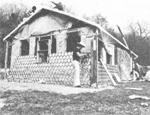 PHOTO BY THE AUTHOR |
|
|