Lady Godiva Rides Again!
By Richard D. Reed
January/February 1979
It's a policy around our place to try a newly released or unusual vegetable each year, and that's how we came to know "Lady Godiva ... the pumpkin with naked seeds".
My family has always loved the taste of pumpkin seeds(either as a healthy at-home snack or for "backpacking power" out on the trail) but the typically sharp-edged leather-hard hulls really used to dampen our enthusiasm for these autumn treats.
Lady Godiva, however, has changed all that! You see, this hybrid pumpkin features seeds whose shells have been bred down to a light cellophane-like film, and-in the four years since we discovered Lady G.-we've never grown any other kind of pumpkin.
Of course, this naked-seeded jack-o-lantern does have some drawbacks. If you like a rich, golden-colored pumpkin, for instance, you'll have to look elsewhere. Godiva's hue, even when ripe, often tends toward yellow with pale green stripes. Obviously, looks aren't everything, but this fruit is also more thin-skinned and just a little less tasty than other pumpkins we've grown ... though nobody will turn his or her nose up at a Lady Godiva pie! On the positive side, however, Lady G. pumpkins will keep (when stored at 50 to 55°F) for about three months.
We don't can any pumpkin "flesh" (though we do dry some for soups), so we're only able to use about 40 of the four- to six-pound globes each year ... including the not-so-mature or slightly spoiled pumpkins that go to our chickens after we've plundered the seeds. (In case you're wondering, it takes about 20 of the fruits to produce each pound of cleaned seed.)
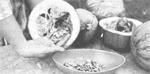
Those little "pumpkin nuts" can be a real chore to separate from the fruit's stringy innards, unless you know how! If you consider your pumpkin to be a globe-with the stem marking north-you should slice right around the "equator". Then, find the three (or sometimes four) pairs of seed rows that are arranged around the inner center of each "hemisphere", reach in along the outside of these rows, and--with the tips of your fingers-"milk" the seeds from their clinging umbilical fibers cleanly and easily!
Whenever we harvest a bunch of pumpkins (about once a week during the season), we put the seeds in a drying rack on top of the stove and put the halved, hollow fruits in the oven.
Once the pumpkin halves are baked (they need about an hour at 400°F) we scoop out the flesh and run it through a colander. The stringy stuff that doesn't strain through becomes worm and chicken feed, and the rest is ready for pie, bread, or cake baking.
And what about the seeds? Well, only about half of 'em ever get the chance to dry fully, because a lot are eaten plain ... and even more are fried or baked-in a little oil-until they "puff", then served with just a dash of salt.
Most seed companies have one or more "naked seed" pumpkins in their lineup. In fact, we've just about decided to try one of these newer breeds this year. After all, the updated varieties might prove to be every bit as "revealing" as Lady Godiva was!
EDITOR'S NOTE: Lady Godiva pumpkin seeds are avail able-for 50 cents per packet-from the W. Atlee Burpee Seed Co., Warminster, Pennsylvania 18991... as well as from other seed distributors,
 |
|
|