The Corbin Carrier
Building an inexpensive and easy to build sled for winter hauling.
January/February 1979
Last fall, the southern Maine "rainy season" lasted-with soggy consistency- Tight up until early December ... when it gave way to a snowstorm that dumped 14 inches of picturesque white fluff on top of the already saturated ground. Because of the freak weather, my winter's supply of firewood was stranded several hundred feet from the farmhouse, and even a helpful neighbor's tractor couldn't negotiate the muck and slush to haul that fuel in.
I was pretty much resigned to spending a cold winter (except for the sweat that I could count on working up every time I had to carry in an armful of snow-covered wood), and the fact that some of my country-born neighbors were also caught short of firewood may have made me feel a little less foolish, but it didn't warm me up a bit.
The situation stayed about the samealthough my spirits did improve somewhatuntil two good friends of mine, Ray and Sally Landry, arrived at my homestead from central Maine for a Christmas visit.
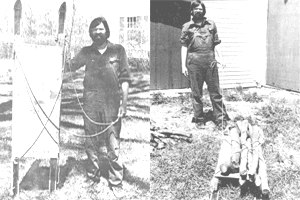
The Landrys had recently built a log cabin a good ways back in the woods and were stuck with a six-mile carry every time they had to bring in supplies. But, though ordinary sleds just bogged down in the deep snow (and toboggans were out of reach of either the homesteaders' budget or construction skills), Ray and Sally had solved their hauling problems. It seems that a friend had taught them how to build a sled out of old wooden downhill skis ... and that the simple cargo hauler sneered at the deepest snow. The Landrys call the device a Corbin carrier ... named after the man who introduced the easy-to-make sled to them. And, now that I've brought in my wood supply on my own ski-sled, I can understand Ray and Sally's enthusiasm for this great little inexpensive workhorse.
HERE'S HOW TO MAKE IT
Corbin carrier construction begins with an old pair of wooden skis. If you don't already have these items stuck back in a garage or attic comer, check out your local ski exchange, Salvation Army, or Goodwill store. In the Northeast, at least, these outlets usually have plenty of worn-out wooden skis -often disguised with gaudy plastic coatingsthat they'll either give away or let go for less than a dollar.
Once you locate a pair, attach each ski's upper surface to a length (about four feet) of two-by-four or other scrap lumber (keep these boards of equal length). I used 10-penny nails to fasten my sled's "sides" to its runners, after I'd drilled some 5/32-inch pilot holes to help the fasteners penetrate the tough hickory skis.
Once the two-by-fours are in place, just add a few crosspieces to make your sled whatever width you want. (Since I had three 9- by 17-inch maple planks-salvaged from an old pallet-around, my carrier is 17 inches wide.) Then, nail a solid "top" to the crosspieces (I used a 42- by 17-inch piece of masonite) to make cargo loading easier and to keep brush from poking through the middle of the sled and hanging it up.
Some sort of U-bolts, Screw eyes, or hooks should be fastened to the corners of your Corbin carrier ... to be used when you have to lash down a load. It's best to tie cargo in place in a "crossover" pattern, using rope, elastic "car top" fasteners with hooks (these are about the best), or even a strong cord with some strips of old inner tube attached to it for an elastic effect.
Finally, fasten the ends of a long piece (about 14 feet) of rope to the fronts of the two-by-fours to serve as a hauling "harness". (Just loop the cord around your waist and make believe you're Sergeant Preston ... or maybe King?)
You'll be amazed at how versatile these simple sleds are! For instance, suppose the snow is deep enough to bog down the ski-tips ... you can simply drill holes in those tips, tie rope to 'em, and then bend 'em back by lashing that cord to the front crosspiece. This will create a curved runner surface that'll ride over deep snow like a toboggan!
Of course, it can be a chore to pull a heavy load uphill on a ski-sled, but-once you get going on fairly level ground-Corbin hauling is a not unpleasant form of exercise. Most important, though, is that these little sleds really work ... and when you've got a heavy load by your side and a mile of deep snow in front of you, a Corbin carrier can be worth its weight in gold.
 PHOTOS BY CARTER WENTWORTH |
|
|