By Hickory Dickerin', Doc!
September/October 1978
Homesteader William James earns up to $8.00 an hour for the peaceful time he spends in the autum forest... how does he do it?
Ten years back-when I took my initial walk through our homestead's woods-I filled every available pocket in my jacket with wild nuts from the numerous tall hickory trees scattered throughout our ten acres. That was the first time I tasted the rich "walnut and rum" flavor of these excellent edibles . . . and the first (but not the last) time 1 smacked a finger or two as I tried to crack the hard, pale nutshells.
My wife and I have lived in these woods ever since that first magic autumn a decade ago. And each fall we take advantage of our nut crop . . . just as we forage the dewberries and plums of other seasons.
Furthermore, as we've learned the locations of our trees-and become better at beating the squirrels to a fair portion of the crop-our nut baskets have grown in size from quarts to pecks to bushels. In short, it wasn't long until we found that we were harvesting more hickory nuts than we could ever use. So . . . we decided to try to sell our surplus.
NUTS TO YOU . . . FOR A PRICE!
At the time, we had already attempted to market foraged wild foods once before without any real success. But that had been pecans . . . which took forever to gather, didn't weigh much (our markets buy by the pound), and-because they are very susceptible to insect pests-didn't produce reliably large crops every year. We finally gave up on the pecans as a salable commodity ... though we always had-and still have-enough for personal use.
Hickory trees, on the other hand, aren't particularly vulnerable to much of anything. We've found that our hickories produce at least something every year . . . and each fall one or two can be counted on to yield a "bumper" crop.
Furthermore, hickory nuts are heavy. One person under a good tree can easily collect twenty pounds of the hulled but unshelled delectable edibles in an hour! Since we get 40 cents a pound when we sell our free-for-the-gathering nuts to local merchants (mostly "organic" food stores and an occasional supermarket), that means our "wages" for a pleasant day in the woods figure out to about eight dollars an hour. [EDITOR'S NOTE: We checked with several North Carolina health food stores and found that most were interested in buying foraged hickory nuts. None of these outlets could quote us a per-pound figure, however, simply because no one had ever brought any in to sell to them! We also found that some supermarkets will buy hickories as sort of "wild-pet food" . . . to attract suburban squirrels!]
My wife and I have noted that the larger stores resell our nuts for as much as 60 cents a pound, while a local co-op only asks 46 cents for the same quantity. Either way, though, the customer gets tasty meatless protein for a price that's less than half that charged for most other sources of this necessary substance. Nobody-in other words-gets ripped off in these wild hickory nut transactions.
And because of the low pricein addition to their good taste and "folksy" appeal-wild hickory nuts do sell easily. Last year we marketed a total of 450 pounds (all that we could spare) .. . which put a handy $180 in the of sugar bowl!
FINDING THE FOREST, FOR THE TREES
If you live almost anywhere in the eastern two-thirds of the continent between southern Ontario and Florida, you're probably within a few miles of one species of hickory or another. The trees usually can be found in rich, reasonably moist soil . . . both in forests and bordering cleared land. City folks often can locate substantial stands of these darkbarked giants in parks or along those (usually older) streets that have been able to preserve their shade trees despite the "lop 'em off' pressures of the phone and power companies.
Even in heavily populated areas, there generally isn't much competition for the hickory nut harvest. Most people, it seems, don't know one of the hardshelled goodies from a cereal commercial. And those who do can be pretty much divided into two groups: The folks [1] who would rather have someone else (like you) gather and sell the harvest . . . so that they can buy it and not risk the stigma (?) of being seen foraging themselves, and [2] the poor unfortunates who-out of ignorance-think that the tough husks and small meats make hickory nuts just plain not worth the bother (the sidebar that accompanies this article should help to change that misconception).
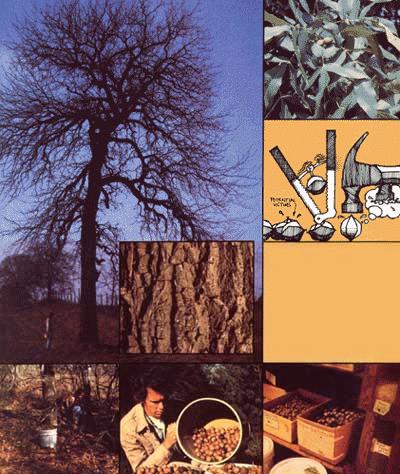
So (luckily for you) with so much misinformation around, you probably won't have to fight too hard for ground space under your favorite tree. And that "private" hickory won't be difficult to identify, either. If the photos on these pages aren't enough for you . . . most any library should have an assortment of field guides that will do the job. Furthermore, as soon as you've located just one of these trees, you'll probably become aware of a number of others all around you that you've been overlooking for years (once your eyes have been opened, there's something distinctive about a hickory). Don't worry about which of the several species of the tree you find yourself under, either. Though they do vary in the quality of their flavor, any mature and healthy hickory nut you're likely to find will be "good enough to eat".
And here's another tip: Keep an eye peeled, too, for old dead trees-and fallen limbs-in any group of hickories that you discover. The dry wood makes an exceptional fuel . . . it burns long and hot and the smoke has a pleasant aroma. In fact, as I'm sure you know, hickory is the preferred wood for smokehouse use.
Which, of course, is why we've found that some markets-in addition to the nuts that we sell-are glad to buy split and sacked hickory wood. However, if you try your hand at this business, please remember to salvage only individual timbers that have no recent growth. Living hickories are too valuable-and beautiful-to be turned into fuel.
And save some of that wood and those nuts for yourself, too! A good portion of our hickory harvest-wood and nuts-ends up on and in our cookstove when we prepare "special" goodies for all those holidays coming up. The nutmeats can be substituted in (and will improve) any recipe that calls for walnuts or pecans . . . and hickory nut bread-especially when baked over a hickory fire -is several magnitudes of delicious better than ambrosia!
HICKORY CONSCIOUSNESS?
All over America, every day, land is converted-violently-from forest to field. Though federal agencies and lumber companies do sometimes reptant, they seem to favor the various pines for their reforestation projects ... while our deciduous trees (the ones that shed their leaves every year) continue to get pushed back-month by month-onto a smaller and smaller section of the landscape.
Maybe if more people tasted hickory nuts-or just spent a little time under these trees-the shaggy titans might come to be considered an asset (like fruit trees, for example) to a, piece of property. Perhaps "hickory consciousness" can save some of these nut bearers from the 'dozer and chain saw . . . and increase this country's appreciation for its other wild foods in the bargain.
Heck, we always knew that Euell Gibbons wasn't really advertising those Grape Nuts, didn't we?
STILL CURIOUS?
More information on hickories can be found in "Food Without Farming", MOTHER NO. 7, pages 71-76, which is available for $2.50 plus 95 cents shipping and handling from THE MOTHER EARTH NEWS(restricted), P.O. Box 70, Hendersonville, North Carolina 28739. And an especially good large paperback field guide, The Tree Identification Book by George W.D. Symonds (William Morrow, 1958), is available for $6.95 from good bookstores, or for $6.95 plus 95d shipping and handling from Mother's Bookshelf, P.O. Box 70, Hendersonville, North Carolina 28739.
Happy foraging ... and may the local market for hickory nuts in your area be as good as the one I've found down here in south central Texas!
How To Crack a Hickory Nut
First, off, there isn't anything I can tell you that will make your hickory nutmeats pile up as rapidly and as easily as, say, walnuts. However, as with most tasks, there's a right way and a wrong way to open these stubborn little cusses.
If you have a nutcracker, simply place the nut so that the two pointed ends contact the surfaces of the tool (see drawing). Then apply firm-but controlled-pressure to crack the shell. Experts can open hickories so that the meats fall out whole most of the time... but you should content yourself (at first) with a few big chunks. Use a nutpick or a large pin to remove the rest.
When you crack a hickory nut with a hammer, make sure that the nut is placed point down on a hard surface. Your first good blow should crack the shell into accessible segments. You then can break each of the individual pieces open by directing your mallet to the outside of its husk... while keeping the shell as nearly perpendicular to the floor (or whatever) as you can.
Be sure to throw those scraps of shell out for the birds and squirrels, too. They'll be happy to pick out the tiny pieces of meat that you overlooked.