The Wisdom Of Helen And Scott
July/August 1978
Issue # 52-July/August 1978
A we've noticed several time in these pages, Helen and Scott Nearing are light year ahead of most of us when it comes to getting back to the land and living a life of voluntary.simplicity. well they should be, since they originally homesteaded a run-down farm in Vermont's Green, Mountains away back in the autumn of 1932.
Life was good for the Nearings on that mini-farm . . . until the slopes around them explode, into ski resorts in the early 50's, forcing Helen and Scott to move on to a rocky inlet on the coast of Maine and start all over again.
And that's where you 71 find the Nearings today: still clearing brush, still building hone., stone houses (Helen and Scott are famous for their stone houses/, and still raising most of then: vegetarian diet themselves in unbelievably productive wholistic gardens . . . just as they're been doing for nearly 50 years.
Naturally (in more ways than one/, the Nearings have learned a few things about homestead ing and getting back to basics over the years. And, lucky for all of us, they've agreed to share, some of that knowledge with MOTHER's readers in a regular question and answer column. 1! you'd like to get in on the action, send your question or questions about self-sufficient living on the land to Helen and Scott Nearing, THE MOTHER EAR THE NEWS P.O. Box 70, Ho dersonville, N.C. 28739. And please don't expect personal replies to your queries. The most portant and most frequently asked questions will be answered here-and here only-whet all can read what the Nearings have to say.
My people came from Maine, and since childhood I have been trying to fight my way back. It may take me a few years, but I'm studying silversmithing and hope to be able to make a living, in the Pine Tree State once again someday. I'm single (divorced), 43 years old, and I'm pretty strong. My mother is 69. I don't think we could make it on a farm . . . but I'm not sure about this. Do you think two women, such as my mother and me, might make it on the land? Do you know of any city women who have done so? And do you know whether or not cheap land is still available in Maine?
We cannot tell you whether or not two women can make it living on the land today in Maine because we have no idea how much you know and how much work you can stand. Also we have no idea of how you want to live . . . hard or soft. It is not easy to dig a living out of a piece of land . . . even for sturdy, vigorous people. Sooner or laterif you're so Inclined-you can try and see. Do not expect that the project will push itself through to success, though. Expect plenty of work . . . and frequent setbacks. Be prepared to work hard and competently for several years on a carefully planned and financed project.
Have you any suggestions for removing stumps? I must clear a 30-year-old second-growth forest which was once plowed and presently is all stumps.
We have dug out very few stumps on our homestead. We prefer to let them rot in the ground, mulch them heavily, and plant between them.
Have you ever had experiences-good or bad-with underground housing? None at all.
What is the best way to select blueberry plants . . . and at what age?
Use 2-year-old plants only. Get at least several different varieties and decide which is best for your neighborhood. A selection of different varieties also helps in cross-fertilization.
What are your conclusions about the advisability of drinking milk and using milk products . . . such as yogurt, curded cheese, etc.? Also, do you recommend the consumption of distilled water . . . and, if so, why?
Milk products are probably deleterious for people who have a natural inclination toward mucus in their nasal passages. For people in normal health, however, a minimum of milk products may be desirable. We do not drink milk, but occasionally use cottage cheese and yogurt. We live in a region where the potable water is pure . . . hence we have no experience with drinking distilled water and can make no recommendation about it.
I have always lived near Washington, D.C., and I have had a lot of outdoor experiences. My questions are concerned with moving out of the city into the country . . . and getting away from it all. I am only 18, but someday I want to do something similar to what you have done. I'm not sure how flexible and adaptable I am . . . but I have the will. Here are my questions: [1] What kind of adjustments did you have to make psychologically? [2] How did you get along at first? [3] Did you have any prior knowledge of farming, the construction of houses, hunting, etc.? And [4] do you have any sources of news, such as a newspaper.
Here are the answers, one at a time: [1] Scott was born and grew up to age 14 in a small Pennsylvania coal mining and lumber camp where almost every house had a garden, chickens, a pig or two, and a cow. Many also had horses. It's hard not to let some of this kind of life rub off and serve you in later life. Perhaps your "outdoor experiences" will help you when you make your move into the country. [2] Moving to the hills of Vermont was no problem. We quickly learned how to deal with nature, earth, and weather. [3] Members of Scott's family were engineers . . . mainly civil engineers. They were always building something whichyes-did give Scott prior knowledge that we applied when we moved to our homestead. [4] We subscribe to three daily newspapers . . . in addition to a dozen or so weekly newspapers and monthly periodicals.
Don't be in a hurry to move into a new lifestyle. Proceed one step at a time. it first during your vacations . . . i the year-around. Don't try to live a!, Live with at least one other person and a group of like-minded people ca i, much more stable than a couple. Be your economics are sound. Don't bot money because you will then have to, back what you've borrowed plus in est, which is always a drain on v finances. Do not expect immediate, turns from your labors . . . even radio take 24 to 25 days of good, warm wear a to mature. The lifestyle of country lip is completely different from that of city. Suburbia tries-unsuccessfully combine the two. Don't go into court living until you are prepared to s:. with it and make a go of it.
I am intrigued by your life, ideals, . beliefs . . . but I do have a few question First, I'm not really sure why you chosen to remain in the United State r rather than move to a country wt. would be more hospitable to your idea would like to know whether you would advise a young person to move t, socialist country if he feels cramped our capitalist nation. I have been thinking ing of joining the Peace Corps to try one or two countries . . . while learn: about other people and other culture and doing some service for mankind Maybe you can suggest some good bot (yours and others) which would be h< ful for me in gaining a better understa ing of socialism and capitalism.
First, our homestead in Maine is w, assigned post. We're here to do a job a f must stick with it. I'm not sure we would advise anyone to move to a socia
country, but your idea of joining for Peace Corps as a means of learning about certain socialist nations is a go: , one. If you do join the Peace Corps, yap.; service to your fellow man can be its own
reward . . . right along with your pour: cal learning experiences. For a begin: ning study of socialism and capitalists;. try reading the UNESCO History I; Mankind (Cultural and Scientific Development opment), Vol. VI, "The 20th Century, Harper & Row, also available from Allen Unwin, Reading, Massachusetts.
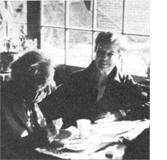 STAFF PHOTO |
|
|