The Shipps Sportster:
March/April 1978
AN ELECTRIC MINI-CAR FOR URBAN DRIVING
California aerospace engineer Paul R. Shipps has had long and varied experience in the design, development, and testing of rockets, aircraft, and other advanced vehicles.
Six years ago, when Paul started his own small advanced-vehicle design, consultation, and testing business-however-he had something more down-to-earth in mind: the creation of energy-efficient, environmentally kind, day-to-day personal transportation.
In recent months, Paul says, even this work has been slowed in order to allow for the attack on a still more urgent problem: the rapidly multiplying government regulations which have already made the use of innovative and efficient mini-vehicles like the ones he has in mind nearly impossible in this country.
Paul's written a $3.00 booklet, Electric Mini-Cars for Urban Driving, which began as an educational handbook on electric cars, efficient energy use, and small car safety. As it turned out, though, the fact filled publication is also an expose of our nation's poorly-thought-out vehicle safety regulations.
At present, only one Shipps-designed mini-car-the three-wheel, 2.5-horsepower, maximum-30-mph "Sportster" shown here-qualifies for marketing. Paul expects to have plans for the vehicle available (for $15) by the time you read this. And he'll soon be offering three-part kits which can be assembled into your own Sportster at a total cost of about $1,200 (excluding batteries). With the kits will come full-size template blueprints to simplify construction for the amateur.
Paul estimates that it will take one individual three months of spare time to put together one of his mini-cars. If you'd like to order a copy of his booklet, a set of his plans, or the first section of a three-part kit, write to: Paul Shipps, 3E Vehicles, P.O. Box 19409, San Diego, Calif. 92119.
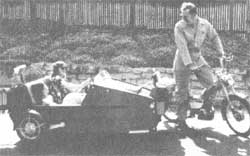 Both the moped shown here and the electric mini-car are classed as motorized bicycles. Actually, though, the 825-pound mini-car uses less energy per mile than does the 150-mpg, 100-pound moped! |
|
|