New Directions Radio
Part Two of Copthorne's MacDonald's slow scan television.
By the Mother Earth News editors
March/April 1977
Below, Copthorne Macdonald-the inventor of slow scan television-concludes the two part discussion of SSTV in began in MOTHER NO. 43
ALTERNATIVE TELEVISION
Last time-you'll recall-we talked at some length about slow-scan TV (SSTV for short), which we said was a means of [1] converting a picture into sound frequencies, [2] transmitting that "sound" via telephone, audio tape, or ham radio, and [3] converting that same signal back into a picture on the receiving end.
We also mentioned the fact that because SSTV pictures are sent at the rate of one frame every eight seconds (in contrast to "regular" TV pictures, which are broadcast at 30 frames per second), the arriving SSTV image must be stored for viewing ... either; In the afterglow of the special long-persistence phosphors used in SSTV viewing screens, or in the digital memory chips of a device called a scan-converter.
Basically, a scan-converter works like this: First, a standard 525-line, 30-frames-per-second TV signal is fed into the scan-converter unit. (The signal would normally originate from a small closed-circuit TV camera, but it could just as easily be a cable TV-or off-the-air broadcast TV- transmission, or the output of a video tape recorder.) Every eight seconds, the converter "snatches" a single frame from the stream of incoming video information and freezes that image in its digital memory. This stored picture; Is then slowly transmitted out over the next eight seconds as a slow-scan signal (which can-in turn-be sent via ham radio).
In its receiving mode, the scan-converter "writes" incoming slow-scan pictures into digital storage during the eight seconds it takes each frame to arrive, then reads this picture information out of memory non-destructively at 30 frames per second into an ordinary TV monitor, where it's displayed as a bright, non-fading picture for as long as one cares to view it. (Scan-converters also have "continuous update" capability, wherein each newly arriving image replaces the old one line by line. Here again, the picture you see is as bright as any' thing you're likely to get on your home TV, and doesn't fade or flicker.)
Amateur radio buffs who want their own scan-converters have two options: build or buy. George Steber (WB9LVI)-one of those who've chosen to go the first route-has designed a unit that performs well and that has been copied successfully by many other hams. To help other folks get Into SSTV, a group headed by Ed Arvonio (W3LY) Is making available at cost some of the key components used in the construction of George's converter. For $150 (postpaid within the U.S.), Ed can supply a set of the 15 bare printed circuit boards you'll need, plus about 50 sheets of construction information ... and for an additional $198.20, you can have a set of the 76 required Integrated-circuit memory chips. All other parts, however, must be rounded up by the builder him/her self. (See George's articles in the March, May, and August 1975 QST magazines-$1.50 each postpaid from 225 Main St., Newington, Conn. 06111 -to get an idea of the other components you'll need.) You can contact Ed at 35 Franklin St., Feasterville, Pa. 19047 ... but please enclose a stamped, self-addressed envelope If you do write, to make Ed's life easier.
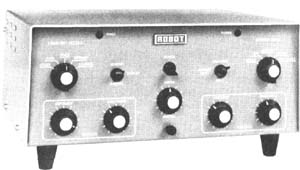
Happily, amateurs no longer have to build their own scan-converters: Nowadays, it's also possible to buy one ... thanks to Robot Research (7591 Convoy Court, San Diego, Calif. 92111). The first company to market pre-built SSTV gear back in 1970 (and a leader in the field ever since), Robot is now first again with their new Model 400 scan-converter. At $695 retail, the Model 400 (pictured below) isn't exactly low-cost ... but considering the job it does, it is an outstanding value. (I might mention that Robot has so much confidence in the future of the scan-converter approach, they've actually stopped making their other "old style" slowscan monitors and cameras!)
Should you need a closed-circuit TV camera with which to feed your Model 400 converter, Robot sells an RCA unit for $260. They also offer a 10" fast-scan monitor for $225, (Note: Some home TV's can be converted fairly easily to fast-scan monitors, although I prefer a smaller screen size-say 5" to 7" diagonal-than most TV's come in.) Add it all up, then, and you're talking about $900-$1,200 for a complete SSTV station consisting entirely of new off-the-shelf components. (Isn't this one of those situations where it'd make sense for a group of people to got together and share the cost of equipment?)
The arrival of factory-built scan-converters on the SSTV' equipment market it-of course-good news for us New Directions Radio folks. It means-first of all-that newer, better equipment is available for those of us who can afford it ... and-secondly-that more used old-style equipment should be coming on the market now, as hams trade in their first-generation SSTV rigs for the new scan-converters. (I've already heard of one fantastic buy: a used Robot Model 80 camera-and a Model 70 monitorfor $125 each!)
If you're interested in obtaining SSTV gear, I'd highly recommend you [1] check the classified ads in OST and other ham magazines, [2] send a stamped, self-addressed envelope to Buyers and Sellers, Box 73, Boston, Mass. 02215, for their current equipment list, and/or [3] send $1.00 to Ham Trader Yellow Sheets, Sycamore, Ill. 60178, for a four-issue subscription to their journal, which lists used equipment.
Cost has long been a major deterrent to the would-be SSTV users among the NDR ranks. (The folks who share our interest In Now Directions generally haven't had the money to buy gear, and most of the people who do have the capital haven't shared our interests!) It looks, however, as though the cost of this very useful communications tool is-finally-dropping to a reasonable level.
A FINAL WORD
I know of three New Directions hams currently active with SSTV: Craig Roberts (WB5HKO, 411 Burgundy St., No. 9, New Orleans, La. 70112), Randy Livsey (WB8SPT, 7506 Andersonville Rd., Waterford, Mich. 48095), and myself. We'd like to share ourselves and our interests with you on the air, using pictures as well as words. Why not tune us in, or drop us a line?
Till next time ....
Peace,
Cop Macdonald (VE1BFL)
99 Fitzroy St.
Charlottetown
Prince Edward Island
Canada CIA 1 R6
 The new Robot Research Model 400 slow-scan/fast-scan scan-converter (which retails for $695) permits a bright, non-fading display of SSTV pictures on a conventional television monitor or modified TV set. In addition, the unit allows ""stop motion"" transmission of video images from a standard closed-circuit TV camera. |
 This is how a normal TV screen displays a picture stored in the Robot scan-converter's digital memory. |
 |