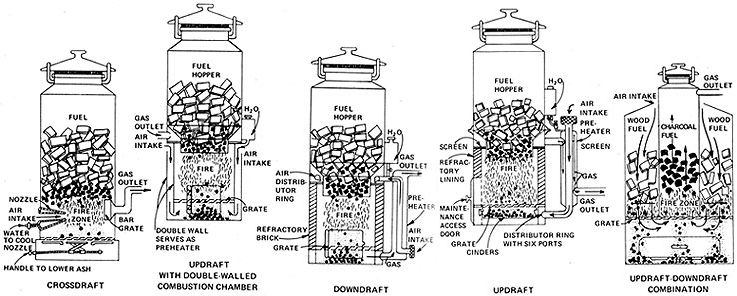
The five diagrams illustrate the most widely used types of producer gas generator. As you can see, the devices differ in location of air intake and gas outlet ...and consequently in the direction of draft. The crossdraft model at far left is effective and easy to light. It is, however, tricky to construct and its nozzle must be water-cooled to withstand the high temperatures created in the unit's fire zone. The second generator—an updraft type—shows a refinement of firebox design: a double wall which serves both as insulation and as a preheater. Next in line is a downdraft generator, which has the advantage of "cracking" some of the tarry impurities in the gas as it's drawn through the fire zone to the outlet. Number four, a simple updraft design, is probably the easiest to build and also is said to have a higher production rate than downdraft or crossdraft systems. Last in the series is an ingenious variation which combines the updraft and downdraft design. Vapors from the heated wood pass through the combustion chamber where many of their impurities are broken down. The reaction of the steam with the charcoal in the inner compartment then produces a relatively rich fuel high in hydrogen content. Any of these models can be conveniently constructed from a mild steel container such as a 55-gallon drum.