The Busy Galley: The Servant Blade
By Jan Adkins a Catcher-In-The-Rye
March/April 1973
Given time, and given the aesthetic sensibilities of a hunger-crazed ape, you can carve out a joint of meat with a wooden shovel. But when you cook for joy and art, you need a tool that will afford the niceties of clean cut and proper thickness. You need a blade as sharp as Occam's razor.
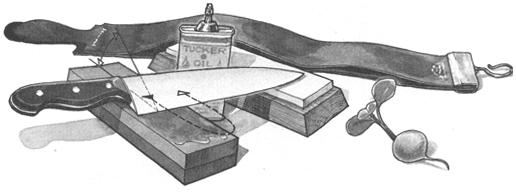
Sharpening a blade is greatly a function of retaining one angle to form a clean edge, without rounding or jogging. The ideal sharpening angle differs with the steel, but 15°-20° is a good range for kitchen cutlery. • A dull knife begins on the coarse India stone. This shapes more than sharpens; it forms the angle of the blade but leaves it gouged and rough with a ragged edge. The stone is well-oiled with petroleum, heavy mineral, or neat's foot oil. The oil floats metal dust away from the cutting surface, leaving it free to cut again. The oil should be wiped away and replaced at intervals. The main stroke is made into the blade, and the back stroke draws it along the stone with a very light pressure. • The smooth India stone follows the angle shaped on the coarser grit, honig it more evenly. The smoother the grit, the more critical the oiling and wiping, since a shallower surface clogs more quickly. • A blade's wear begins at its imperfections. The smoother the edge, the sharper and harder it will be. Polishing the edge on a Hard Arkansas stone (for knives, chisels, plane irons and other tools) or a Steel (mostly for kitchen knives) brings it to a smooth, even sharpness. • Steel is malleable and ductile. As the underside of the blade is being cut away on the stone, the very edge of the top is being draw out in a thin, folding sheet called a feather edge that rolls over and dulls itself. The feather edge is loosened by drawing the blade back along the stone lightly-on one side, then the other. • A note on steels: early stainless allows were very ductile and the feather edge was problematic. Carbon steel was prefferrable, but more recent alloys have overcome earlier deficiencies, and there is no reason not to enjoy the convenience of rust-free blades. When the feather-edge breaks away, it leaves a microscopically dull edge. Stropping draws out the edge sharp again. Stropping is traditionally done on ox-leather, or treated canvas, though some carpenters use some soft wood, draw one side along it, then the other.
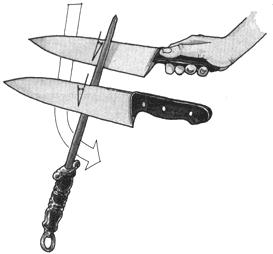
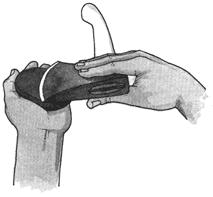
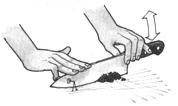
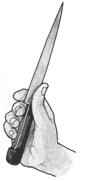
The steel polishes and refreshes the edges of the kitchen blades. It is held upright and the knife is brought down and back on alternative sides. The feel of experience retains the angle on both sides. The tip of a blade is often neglected; grasp the flat of the blade up near the tip and give the tip special attention.
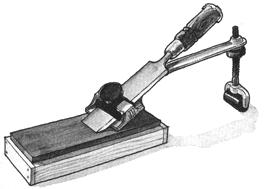
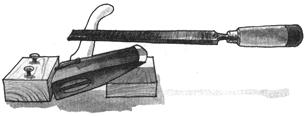
The sharpening angle of chisels and plane irons is especially critical. There are several devices that hold the blades rigidly at angle to make sharpening easier and better.
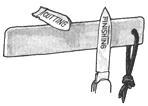
Inveterate whittlers and pocket-knife tinkerers, as well as trappers, nurserymen and ropeworkers, may find a pocket steel like this Gerber useful for constant keenness. The grooved edge shapes and the abrasive flat finishes. Another great advantage is that the strong chisel-shaped steel pries, hacks, wedges, and performs all the jobs that can bollix your knife.
An axe or hatchet is immobilized and filed to proper bevel, then a round stone is useful for sharpening and refreshing the edge.
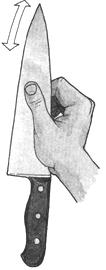
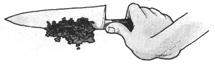
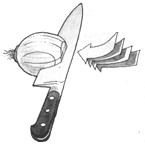
The French Cooks Knife is a deceptively simple instrument that a good cook can use with the grace and flair of a kendo swordsman. It has reached such a peak of simple effectiveness that no one thing can replace its many functions. It is held almost like a fencing foil, controlled by the thumb and index finger on either side of the blade. Its elegant proportions and balance make even a large knife responsive and quick. The blade rocks and pivots on the curve at the tip, and the straight run of the blade minces one way, then at right angles, as fine as desireable. The strong, straight back gathers and slides cut material aside or into bowls. Such an admirable, functional, beautiful tool!
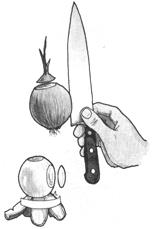
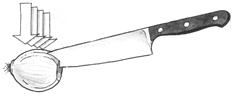
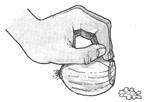
A french cooks knife dices an onion: the stalk top is cut off and four or five shallow slits are made down to the root end. The knife's tip flicks out one section of peel and the rest are folded out anf twisted off with one turn. The root, where most of the bitter oils that attack your eyes reside, is left, but a slice is taken from the side. The onion is laid on the flat base made by the side slice and is cut horizontally four or five times. The thin tip makes four or five vertical cuts. Using the bunched fingernails as guides for the blade, the onion is sliced at any desired thickness, moving the fingernails back each time for quick cutting. The onion is diced. Elapsed time: 30 seconds.
a kitchen armory
"If you want to do a mechanics job, you got to have a mechanic's tools" Hudson Jayne