The Owner Built Home & Homestead
May/June 1972
Issue # 15 - May/June 1972
THE OWNER-BUILT HOMESTEAD, CHAPTER 5
SOIL MANAGEMENT
There comes a moment of truth in the life of every potential homesteader. That is, sooner or later one finds that he or she must come to grips with the purpose and motivation and inner feelings associated with desire to work the land. This chapter on soil management seems an appropriate juncture to qualify some of these subjective aspects. For one thing, soil is basic to the whole homesteading complex: the person who lacks some special feeling for the soil is not likely to have much feeling for plant or animal husbandry.
Soil management practices, moreover, can prove to be essential tests by which one can judge rapport with the growing process. What is your reaction, for instance, when giant machinery opens up soil furrows, denuding all vegetation for planting monoculture crops to be sprayed with deadly chemicals? Your moment of truth has arrived when you are able to correlate a plow-sliced furrow with a body slash; a denuding of ground cover with a peeling-off of one's skin; an application of commercial fertilizer with habitual injection of barbiturates.
If such feelings for the soil are alien to the average homesteader, it is probably due to the fact that the average homesteader has no comprehension of the exceedingly bad soil management practices engaged in by modern farming. Nor, conversely, does he understand the principles inherent in proper soil management practices.
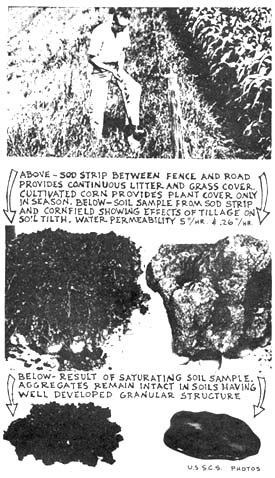
To achieve this understanding, the place to begin is with an investigation of a sample of good soil and a sample of poor soil. In the first instance, soil granules, or crumbs, are aggregated into a structural unity. A disaggregated soil, however, has no structure. Instead, pores are completely filled with water. The soil surface dissolves into mud after the first rain, and after the rain it dries to a powdery dust. When you become able to appreciate the intricacies of soil structure, you are well on the way to an appreciation of food production itself.
An ideal soil structure is one having large and stable pores which extend from the surface to the sub-soil strata. The size and arrangement of soil particles govern the flow and storage of water, the movement of air, and the ability of the soil to supply nutrients to the plants. A ready supply of air is especially necessary so that soil organic matter can be decomposed by aerobic bacteria. Spaces around soil particles also act as channels for conducting water through the soil. About one-half the volume of soil should consist of these soil pores and fissures. Many of these spaces are filled with micro-fauna: the gums and mucilages formed in the microfauna breakdown of organic matter helps to bind soil particles together.
Now observe the sample of earth that comes from the average farm. Tillage and clean cultivation drastically reduce the number of large pores available for the movement of air and water through the soil. Overcropping and monoculture also weaken soil structure. The cultivation of annual crops creates mechanical, chemical, and biological demands on the soil all of which cause the soil to lose its crumb structure.
A revolution against "farm implements"-great destroyers of soil structure-is long overdue. When Jethro Tull invented the moldboard plow, he said "tillage is manure". But we now know that soil tilth is created by decay, not by implements. The primary reason pioneer farmers plowed was to get rid of weeds: when weeds were plowed under the farmer had time to get his forage crop started before wild vegetation recovered from the plowing setback. Plowing cuts loose, then granulates, and finally inverts slices of earth on top of surface organic matter. As a result, bare soil is exposed to the direct eroding action of wind and rain (soil aggregates are badly destroyed through the beating action of rain). In this manner, plowing (as well as other forms of tillage) breaks down the soil structure and leaves the surface liable to crusting, The small pore size associated with surface crust increases the water runoff by restricting water intake, which thereby reduces the amount of moisture stored for future crop use.
As far as I am aware, there are no suitable tillage implements: all destroy soil aggregates-some more than others! For one thing, when surface moisture is just right for tillage, the subsoil moisture content (being higher) is in prime state for maximum compaction. Equipment compaction takes place throughout the whole process of crop production-from planting and cultivating to harvesting. Excessive compaction of moist soil limits water absorption by limiting the supply of highly essential oxygen. Compacted soils, like soggy-wet soils, hinder germination because much oxygen is required to digest the stored foods in seeds. In the germination process, carbon dioxide is given off and a maximum pore space is essential, as the gaseous interchange around the germinating seed must be maintained. Furthermore, the pore spaces must be contiguous-from subsoil to atmosphere. In this way the carbon dioxide can be dissolved with moisture in the surface layers (by capillary attraction) forming carbonic acid. This acid is the most efficient natural solvent of minerals, releasing (in particular) phosphorus and potash for the plant use.
Organic gardening magazines probably receive more revenue from hand-operated rotary plow, like the "Rototiller", ads than from the balance of all other advertisements. Ads that sell these machines to unsuspecting gardeners are just one more example of the innocence flawing the "organic" movement. No amount of organically-produced compost could even begin to compensate for the total destruction of soil structure which these machines deliver. Rototillers are the worst type of tillage implements: soil is not merely cut and turned over, it is sheared to dust. Powdery soils will cake and crust upon wetting and drying. Furthermore, the sharp tines completely destroy such essential soil microflora as algae-which keeps microbes supplied with greens through the production of chlorophyll.
In my judgment, mulch planting has been proven to be the best soil-building alternative to tillage.. Practical mulch planting techniques will be discussed in following PLANT MANAGEMENT chapters; our only interest at this point is how mulch planting aids in the development of soil structure and fertility. Obviously, fiberizing the land with organic matter prevents surface compaction and crusting. Furthermore, this organic matter gradually decays, and in so doing releases carbon dioxide. As we have seen, the carbon dioxide combines with water-forming carbonic acid, which in turn releases essential nutrients from parent subsoil minerals. As the decay process continues, microbial activity leaves a residue of gelatinous and filamentous growth which acts as a collodial complex, drawing particles together into structural aggregations. Again, as we have seen, the aggregation structure acts as a conduit, connecting upper soil layers with the subsoil. Organic matter therefore acts as a regulator of air and water in the soil: the foundation of productive land is based on the organic content of the soil . Force roots, not tillage tools, through the soil.
Mulch planting does even more for soil structure: it sets the stage for the creation of humus. Humus is as important to soil as it is difficult for a person to understand. S. A. Waksman's major work on humus runs to over 500 pages! Farmers in past centuries believed that humus was directly utilized as basic plantfood by crops. Liebig, father of commercial fertilizer, disproved this, showing that plant growth was dependent upon inorganic compounds. Organic matter is fertile only after it is broken down into inorganic forms. However, to depart from Liebig's conclusion, inorganic compounds are made available by microbes in a humus medium and not, as he proposed, applied externally as plant-food!
Humus is organic matter in its decomposed state. It contains the breakdown products and dead bodies of microorganisms-which give humus its characteristic dark color. It is these microorganisms, dying in the humus layer, which slowly decompose organic matter, thereby liberating and making soluble continuous streams of carbon dioxide, nitrogen (in the form of ammonia), phosphorus, and other elements. The gelatinous and filamentous residues give humus the property that binds soil particles into structural aggregations; and this structural aggregation of soil is the most favorable medium for the development of root systems and for the future growth of microbes. Aeration and water-holding capacity is increased: the soil is able to absorb more heat. Heat is also given off as a result of air circulation through humus-especially in light sandy soil where air moves freely as water drains away quickly. More organic matter must therefore be supplied to sandy soil than to clay or silt soils, to prevent this "burning up" of humus.
Humus is a veritable storehouse of nutrients. It is also a cementing agent, binding constituent soil aggregations together: one pound of soil colloidal particles is said to cover five acres of surface. Humus has functions and qualities unknown by modern science: Waksman mentions that when all extractions have been made by known processes there is still 30% of the humus unaccounted for. The most important adage that comes from a study of humus is that growth equals decay: the growing season must necessarily also be the decaying season.
There's another adage that every homesteader should memorize: proper soil management is the care and feeding of bacteria. Microbes are vital to the decomposition of organic and mineral wastes into basic plant nutrients. And, of the microbes that inhabit the soil, 99% are bacteria. The rest consist of fungi, protozoa, and algae. Bacteria are divided into aerobic those which thrive under conditions of abundant oxygen - and anaerobic bacteria, which live in conditions where oxygen has been used up; that is, where pore spaces are filled up with carbonic acid and water.
Activities of soil bacteria populations are fantastic: one type produces antibiotics; one type digests proteins (most important of which is nitrogen); other types gather nitrogen from the air. These latter bacteria live in nodules on the roots of certain legume plants. Nitrogen gas is extracted from the atmosphere and made available to the host plant in return for carbohydrates. Another, even more amazing, type of bacteria lives in association with the feeder roots of certain plants - for mutual benefit: the plant is able to assimilate mineral nutrients more readily.
Earthworms are always included, usually at top priority, in any discussion of soil microbe population. Actually, in comparison with the soil development accomplished by bacteria, earthworms are pikers! At best, earthworms are indicators of good soil fertility, not its cause. Darwin overstated the case for the ubiquitous worm: they have no mechanism for creating plant food, capturing solar energy, or fixing nitrogen from the air. Earthworm "aeration" of the soil is insignificant, and the "richness" of earthworm casting is just one snore organic gardener myth. In reality, the earthworm reduces soil fertility to the extent that it burns up energy passed off as carbon dioxide. The leafy diet of earthworms is especially low in mineral nutrients.
Compost is another organic gardening myth worth exploring in this chapter on soil management. A massive literature on compost making has been compiled by ORGANIC GARDENING AND FARMING editor J. I. Rodale (THE COMPLETE BOOK OF COMPOSTING; 1971; 1,000 pages!), and compost making has traditionally been the farming criterion separating the good guys from the bad guys. In reality, mulch planting is a complete, integral process, requiring no further additives in the form of soil conditioners, amendments, or fertilizers. Organic matter applied in mulch planting is utilized in its entirety, without gaseous loss as is the case whey making a separate compost pile. Mulch planting seems to call for a "sheet. compost" program, where organic matter is spread directly on the ground surface. The only real advantage of centralized composting is where hip excrement is utilized. More on this will appear in subsequent chapters.
Whether one adds compost, or any form of fertilizer, to a soil principle of soil replenishment remains the same, and has little to do with soil structure. Given an adequately based organic content, however, the soil microbe population can create its own nutrient demands in a soil structure that is compatible to the needs of these microbes. Experiments at the New Jersey Agricultural Experiment Station disclosed the fact that fresh residues applied on an equal organic matter basis produced as much as three times the soil aggregation as did composts prepared from the same material. Obviously an "applied" nutrient - whether it be humus-rich compost or commercial fertilizer - cannot have the same influence on soil structure as a more indigenous organic treatment.
As a matter of fact, the indiscriminate application of fertilizers can have a harmful effect on crops: if a little nitrogen added to the soil is good, a whole lot added is not necessarily better! An excess of one fertilizing element in the soil may lead to a deficiency of another. Too much nitrogen leads to a deficiency of potassium; too much potash leads to a deficiency of magnesium. Excessive nitrogen added to the soil may over-stimulate the growth of leaves and stems and interfere with seed formation. There are good arguments against the use of commercial fertilizers which are applied at the time seed is planted: the fertilizer supplies soluble salts for plant nutrition at the very time when the seed is equipped with its own stored-up organic supply. The solubility of commercial fertilizers is much too high in most instances (phosphate rock is treated with sulfuric acid to make it even more available to plants). As soon as plant roots reach these soluble chemicals they go into a spasmodic growth spree, which in turn upsets the delicate soil balance.
Nitrogen is the most important of all fertilizer elements required for plant growth: it regulates directly a plant's ability to make protein. Large amounts of nitrogen are needed, especially at early stages of plant growth, and also because so much nitrogen is lost to the atmosphere as gas, or from the soil through leaching. Pre-agribusiness farmers used to leave their fields in rough-stubble throughout the winter months to facilitate rapid snow and rain penetration into the soil, thereby minimizing nitrogen loss from the sky. All nitrogen comes from the air: it is returned to the atmosphere at the same constant rate that it is removed from the air.
Other elements besides nitrogen can be recovered from the air. Field sorrel, for instance, is an extra-heavy user of phosphorous. It can supply itself even though a chemical analysis where it grows reveals no phosphorous present. Unlimited quantities of minerals are also present in the soil and these essential nutrients are made available to the crop in a properly structured soil aggregation.
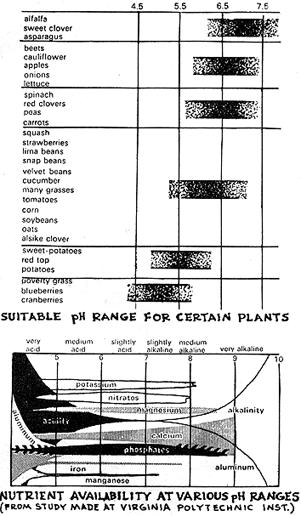
Mineral nutrients can be "locked in" - made not available - when the soil structure is compacted, waterlogged, or where insufficient moisture prevails. Raising or lowering the acidity of a soil can have a major influence on soil nutrients. Raising the pH of an acid soil from 5.5 to 6.4 (making it more alkaline) increases the availability of phosphorous about ten times. And reducing the pH of alkaline soil from 8.3 to 6.9 (making it less alkaline) increases phosphorous availability 500%. The pH (literally, parts-of-hydrogen) refers to the balance of acidity alkalinity. The scale extends from 10 (high alkalinity) to 4 (high acidity). Most plants thrive at a pH range of 6.0 to 6.9. At this range bacteria seem to thrive, thereby speeding the decay of organic matter and the liberation of nitrogen. At a pH below 6.0 only those bacteria which break organic matter into an inferior ammonia are active; at higher pH the breakdown produces more valuable nitrate nitrogen.
A quartz, granite, sandstone, or shale parent soil usually produces an acid topsoil, whereas marble and limestone produce alkaline soil. Ground limestone is traditionally applied to reduce soil acidity. If available, use dolomite limestone as it contains magnesium carbonate as well as calcium carbonate. Magnesium is an important soil amendment. If a soil is too alkaline, apply sulfur or gypsum. It is the oxidation of sulfur that reduces alkalinity. And organic matter encourages sulfur oxidation, which further illustrates the importance organic matter plays in soil management practices. A light, sandy soil - or one highly weathered - requires less amounts of soil amendment to lower or raise pH than heavy clay soils or soils high in organic content. Usually gardeners use either too much or too little lime: at Cornell University several hundred home gardens were analyzed: one-third had too much lime, one-third had too little, and one-third were just right.
Most states have agricultural experiment stations and extension services which will test one's soil for lime and fertilizer requirements. Or one may prefer to do his own testing, using an inexpensive soil-test kit. Purdue University makes the best deal for a soil and plant tissue test kit: a complete setup for $13.75.
Soil for testing should be taken 6 inches deep, where most crop roots live. It is important to keep soil moist several days before testing as drought affects pH by killing bacteria. Also a cold soil inactivates bacteria: so, in order to get a fair pH reading, test warm, moist soil. When using the kit to test for mineral requirements, remember that the availability of soil nutrients varies from day to day and from season to season. In the early spring, for instance, nitrogen is taken up by soil organisms, so on this basis a false reading will be made. Also a single soil sample would not necessarily be typical of the whole homestead. A farm usually has from 3 to 6 types of soils - there are tens of thousands different soil types in the U.S.
Actually, to classify soils into "types" - like Chernogen, Podzol, Prairie, etc. - is rather misleading as well as being unimportant. In the early farming days, before the destruction of topsoil and humus by bad farm practices, soils were made up of thick, black layers of organic matter. And in this respect the part of the soil that was important was the same as any other soil. It is only since denuding the soil of this black mantle that the underlying sandwich layers became discernible and classifiable.
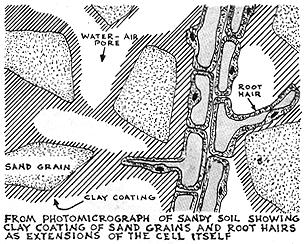
The most important thing that one should know about the soil he works with is the texture of the soil aggregations. That is, whether it is of clay, silt, sand, or gravel texture. As noted in the previous chapter on water management, water percolates rapidly through light sandy soils. Clay soils have greater water storage capacity. Also, and more to our interests here, the finer the texture a soil possesses the more nutrients are available. Fine clay aggregations provide more clinging surfaces whereas in sandy soils water and nutrients are easily leached away. The sandier the soil, the less organic matter it contains. On this type of soil it is imperative to build up humus content so that the filamentous and gelatinous residues of crop refuse will fill up spaces around sand particles and thereby overcome excessive drainage and leaching - and the rapid conversion of organic matter into carbon dioxide and water.
Inasmuch as soil is created primarily by the growth of plants, the best soil improvement method is to grow crops. A soil aggregation of heavy clay or silt particles can therefore best be lightened or made more friable by growing weeds or green manures. A green manure is a crop grown and returned to the soil for purposes of improving the soil. Besides the surface mulch that is made available, roots from green manure crops penetrate deep. When they die and decompose a water conduit is provided through which excess water can drain from the clay subsoil, and down which the roots of the next crop can grow more easily.
Extremely poor, eroded, and structureless soil can be made productive by using green manuring principles: first apply necessary lime; then commercial nitrate fertilizer; then turn the land to weeds. The weeds will thrive on the applied nutrients and penetrate the subsoil with their highly developed root systems. Mineral nutrients will be brought to the surface through the roots of these weeds. Some grasses and legumes will thrive on poor soils; for instance, buckwheat, rye, lespedeza, and sweet clover.
There are other farming practices, crop rotation for instance, which improve soil structure. A discussion of these principles brings us to the subject content of the next three chapters on Plant Management, so basic concepts only will be listed:
1) Legume crops are grown to promote the fixation of nitrogen from the air.
2) Perennial grasses, in a grass arable pasture system, are grown to supply a constant source of humus.
3) The alternation of deep and shallow rooted crops prevents continual absorption of nutrients from the same zone.
4) Deep rooted plants (like alfalfa) improve subsoil structure when roots decay.
5) Keep a cover crop growing during winter months for protection against wind and rain. Always remember: let the surface of the soil wear a beard.
6) Grow green manure crops between regular growing seasons for producing organic matter.
Admittedly, this chapter on soil management fails to even mention some of the issues which are considered paramount in most textbook treatments on the subject. This is not an oversight on the part of the author: only that material which is pertinent to the development and maintenance of soil structure has been considered at this time.
THE OWNER-BUILT HOME, VOLUME 3, CHAPTER 3
WALLS
Man's first wall was built as a stockade around his village. Its function was to protect from intruders and to contain livestock. In the evolution of house forms, herders de-emphasized the importance of the hunter's roof-tent in favor of wall embellishments based on the village stockade. First, he drove posts into the ground and wove wattle in between. Later, he pressed stiff mud into the wattle - a direct predecessor of our ever-popular suburban "half-timber" style.' Finally, a few thousand years before Christ, the wall builders invented the brick, which essentially brings us to the modern scene.
As contemporary man continues to place brick on brick to form the wall - stockade around his "living" space, he armors against life in much the same manner as his pastoral ancestors. The function of walls for protection persists even though the early pastoral significance has been lost in our present non-pastoral communities. Some self-conscious design reformers later succeeded in disturbing these notions when they started the bring-the-outdoors-in campaign. Result; the picture-window became a stock item and indoor planters defied the "outside" feeling as much as the concrete patio did the "inside" feeling.
It's about time we re-examine the wall in terms of purpose and function. A house can be thought of as having many purposes; but primarily it is a contrivance for regulating (controlling) a segment of our environment. This conditioned environment is enclosed with roof, floor and walls so that weather factors such as air movement, humidity, precipitation, temperature, and light may be regulated. Walls are structural membranes separating the indoor environment from the outdoor environment. On the other hand, the greater the difference between the indoors and the outdoors, the more elaborate must be the wall's inherent properties. The more important characteristics which a wall must have include strength and durability, flow-control (heat, moisture and air), and good design at low cost. These are the more significant properties that will concern us in this chapter.
Generally speaking, about one-half of the cost of a house is the cost of the materials which go into it, the remainder being labor costs. With this fact in mind one would naturally assume that builders would have a thorough knowledge of the nature and properties of all building material possibilities. The functional performance of a wall material is number one consideration, but at the same time the most economic solution requires a selection of components having the lowest combination of initial cost and maintenance. This long-range cost is too often overlooked by builders in their concern with how much money must be raised in the beginning.
Among the many considerations for selection and evaluation of wall materials, listed below in order of importance. I would certainly include a seemingly far fetched salvage value. Cheaper and easier demolition becomes significant in this era when the average useful life of a building is comparatively short. Plywood paneling and heavy timber framing have high salvage values; brick and concrete have low salvage values.
Check List for the Selection of Wall Materials
1. initial cost and subsequent maintenance cost.
2. compressive and traverse strength.
3. resistance to natural weathering, chemical attack and atmospheric pollution.
4. combustibility.
5. ease of handling (size, weight, shape) and erection.
6. resistance to scratching and impact.
7. dimensional changes with temperature and moisture content changes.
8. susceptibility to insect attack.
9. appearance in color and texture.
10. moisture penetration resistance.
11. sound insulation and absorption.
12. adaptability to future changes of layout and salvage value.
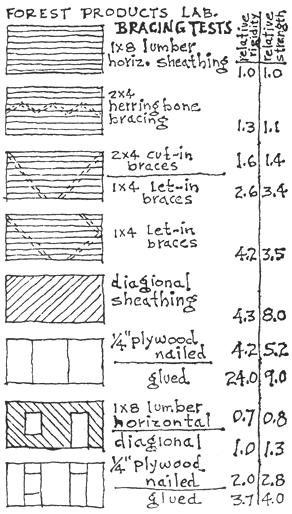
Wall materials must have the necessary strength in compression, bending, shear and tension to carry applied loads and to resist such external pressures as wind loads. Accurate strength properties of the material must be known before one can economically design a wall. In the design analysis it is important to remember that the loads in question apply only to the net width of the wall, excluding door and window openings. From a design standpoint this would suggest greater consolidation of openings and adequately spaced, solid wall panels to provide bracing effect. Types of bracing and methods of fastening are the main factors which influence the strength and rigidity of a wall.
The durability of a wall is more dependent on heat flow (temperature change) and moisture than any other factors. Moisture deterioration can take place in all organic building materials, as such materials are hygroscopic-absorbing moisture from the air in proportion to relative humidity. Dimensional change in a wall primarily causes weakness and failure of fastening members. Practically all wall materials change their dimensions according to whether they are wet or dry. When a wet material is dried, shrinkage occurs; when the material becomes wet again, expansion takes place. But the subsequent expansion is often less than the initial contraction, leading to irreversible expansion. Swelling and shrinking due to moisture-changes also causes a breakdown of surface finishes. The pore structure of organic wall materials easily permits capillary moisture attraction from the atmosphere. As much as 40% of the dry weight of a material can be taken up and held with water. This is to say nothing of direct moisture contact from rain or melting snow.
Wall moisture originating from within the building can be an even more damaging factor than outside penetration. As the inside temperature increases, inside water vapor is transmitted into the wall and there condenses. This condensation results in wetting of structural materials and consequent loss of insulating qualities. It also gives rise to such serious problems as chemical, physical or biological deterioration of the materials (corrosion of metal, spalling of brick, rotting of timber).
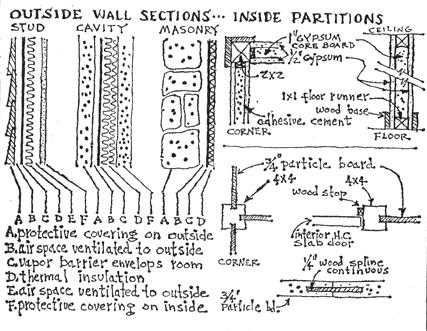
In wood-frame walls a vapor barrier will control inside condensation. But in masonry walls the vapor barrier prevents moisture from entering the room, and consequently, moisture condenses behind the moisture barrier as the hot summer sun follows a rain, driving moisture inside the wall. Waterproofing the outside of a masonry wall will prevent moisture migrations from the outside, but this same waterproofing causes a build-up and damming of water by condensation from the inside. In short, a wall must be designed to limit this entry of water from the outside via capillarity and at the same time permit the flow of water vapor to the outside in winter. But the outside wall should have a partial capacity for water storage, separated capillarity-wise from the inside wall. Furthermore, the transfer of vapor to the inside in summer should be controlled by venting. Obviously, the best choice for a masonry wall is one of the vented-cavity type. Where insulation is used as well as a vapor barrier, a higher indoor humidity is possible without the occurrence of surface condensation. However, incorrect use of thermal insulation can increase the danger of condensation. It can increase temperatures on the warm side of the wall thereby decreasing temperatures on the cold side and causing condensation towards the cold side of the wall.
In the wall-material literature one finds ample reference and speculation on the "wonder" material which satisfies all the requirements of an inexpensive, durable, strong, simply constructed wall. Realistically, this ideal material should also exhibit no thermal expansion, no moisture expansion, be impermeable to moisture, and resistant to heat flow. Also there are summer moisture-heat-gain and winter moisture-heat-loss factors to balance out, so it is quite unlikely that such a miracle product exists or could ever be inexpensively manufactured.
The more practical approach to wall building is for the owner-builder first to plan his walls in relation to areas for winter functions and summer functions, daytime use and nighttime use, inside partitions and outside exposure, bearing walls and curtain walls, storm sides and sunny sides. Our practice of building all four walls of a house of equal thickness and insulation is absolutely absurd. The nighttime, sleeping areas certainly have opposite requirements from daytime, living areas.
The thermal performance of a wall is determined by its (a) degree of direct solar heat penetration through windows, (b) absorptiveness of the exposed surface to solar radiation, (c) heat-storing capacity, (d) insulation characteristics, (e) ventilation rate. Heavyweight wall materials like tamped earth are cool during the day and warm during the night in regions where the daily variation in outdoor air temperature and solar radiation are great. But in regions where the daily outdoor temperature variations are small but solar radiation intensities high, such heavyweight wall materials do not permit sufficient cooling off during the night for comfortable sleeping. In such regions, lightweight materials should be used.
Another gross extravagance in the home building industry is the use of heavyweight materials in non-load-bearing partitions. This is an example of a builder's failure to select a wall material from the point of view of purpose and requirements as well as availability and other economic considerations. An interior, non-load-bearing wall certainly does not require even similar properties as does an outside supporting wall.
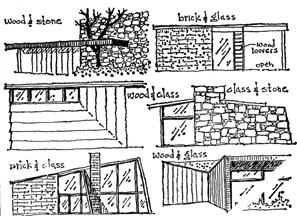
Wall materials in a house should be as varied as window sizes or roof coverings. The success or failure of a wall design-and the completed house as well-is determined by the degree to which the builder relates the wall material to inside and outside environment. A wall is a sort of transition between these two environments; it can express this function with insensitivity or by a statement of simple logic. When peppered with openings and conflicting materials, a wall lacks clarity and composition. Of all that man has created, simplicity of structure is a constant characteristic of the finest. You can get a unified design by reducing the number of materials used, by consolidating the areas and spaces within. You can simplify linear design by extending lines both horizontally and vertically-resulting in a neat, uncluttered silhouette. Simplicity means balance in form, scale, texture and color. Simple structure also means economy. All this is to tell the owner-builder that structure is effective as it satisfies your human need. Set your reasoning to get the simplest, most effective means possible. Immerse yourself in this economy-of-means. After a while you will not have to think effectiveness and balance. It will become part of your nature, with your actions taking place on a more intuitive, non-verbal, non-intellectual level.
BIBLIOGRAPHY (books listed in order of importance)
Fundamental Considerations in Design of Exterior Walls: Hutcheon, Div.of Building Research, National Research Council, Ottawa, Canada.
Guides to Improved Framed Walls: Forest Products Lab., Madison, Wis.
Condensation in Building Walls: Structural Clay Products Institute, A.I.A. File No. 30-A.
 |
 |
 |
 |
 |
 |