Yurts . . . Old
March/April 1971
Blizzards with temperatures down to -50° have howled across the steppes and plains of east Asia for untold centuries . . . and, for many of those centuries, nomadic herdsmen have survived such storms - snug and warm - inside the traditional ger or yurt . Has this modern age changed all that? No and yes: eighty-five percent of all Mongolians still live in gers . . . but the collapsible shelters are now prefabbed in factories.
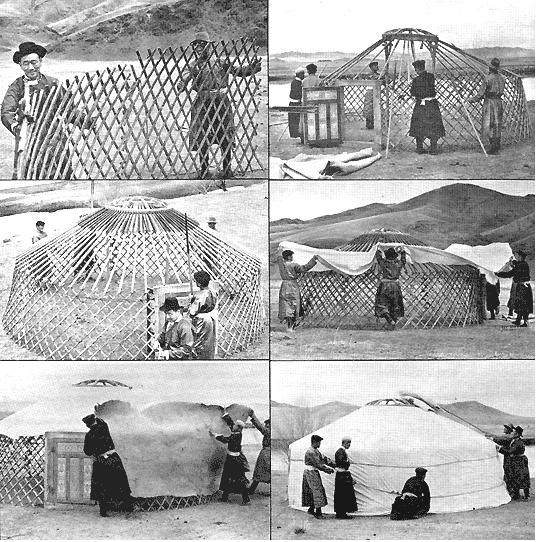
The above sequence shows a factory-made yurt being assembled in less than one hour without nails or bolts. Tribesmen (UPPER LEFT) erect the expanded trellis wall and (UPPER RIGHT) attach roof ribs to a ring held up by two poles. The completed frame (CENTER LEFT) is ready for (CENTER RIGHT) sheets of insulating felt. Felt was invented in central Asia and is widely used the world over in boots and other cold weather gear. The ger's walls (LOWER LEFT) are covered with more sheets of felt and (LOWER RIGHT) a final layer of canvas protects the insulation from rain and snow. Part of the crew then secures the outer covering with ropes while two men use a long pole to spread a separate cover over the yurt's roof ring. Later, the ger's stovepipe will be raised through this top covering and the fabric itself may be turned back to admit air and light on nice days.
 |
|
|